The short answer: oral glutathione may improve some measurements of skin pigmentation, but the human evidence is mixed. Small trials have reported changes at selected skin sites; another trial found no significant advantage over placebo. That does not establish reliable clearance of individual dark spots, a cure for melasma, or superior pigmentation results from liposomal glutathione.
If you are considering glutathione for a more even-looking complexion, the useful question is what the studies actually measured. A change in a skin-colour reading, a visible improvement in a particular dark spot and successful treatment of melasma are different outcomes.
What is glutathione, and why is it used in skin supplements?
Glutathione is an antioxidant that the body makes naturally. It exists in reduced and oxidised forms, usually called GSH and GSSG. Researchers have investigated its relationship with pigment production, including proposed effects on tyrosinase, an enzyme involved in making melanin. [2]
This biological rationale explains the interest in glutathione for uneven tone. Whether swallowing a particular formulation produces a noticeable complexion benefit still requires human research.
What do oral glutathione studies show?
Three placebo-controlled trials illustrate both the potential and the uncertainty. They tested different preparations over short periods, mainly in healthy volunteers.
| Study | What was tested | What the results mean |
|---|---|---|
| Arjinpathana & Asawanonda, 2012 | Oral glutathione versus placebo in 60 healthy participants for four weeks. | Melanin readings improved significantly versus placebo at two of six measured sites. This was a limited signal, not proof that individual dark spots cleared. [1] |
| Weschawalit et al., 2017 | Reduced or oxidised glutathione versus placebo for 12 weeks; 60 participants enrolled. | Overall pigment comparisons did not reach statistical significance. A significant result appeared at one site in an older subgroup, which limits how broadly it can be applied. [2] |
| Sitohang et al., 2021 | Glutathione with vitamin C, alpha-lipoic acid and zinc versus placebo for 12 weeks; 90 women enrolled. | No statistically significant between-group improvement in the assessed facial pigmentation outcomes. A combination formula also cannot isolate glutathione’s contribution. [3] |
A systematic review published in 2025 reported encouraging oral findings, while identifying studies with differing risks of bias. The authors also highlighted uncertainty about lasting benefits. The evidence supports continued investigation; it does not justify a guaranteed dark-spot result. [4]
Does a lower melanin reading mean dark spots will fade?
It can be relevant, but it is not the same endpoint. A melanin index measures pigmentation at a sampled area. It does not automatically tell you whether a particular spot has become smaller, less noticeable against surrounding skin, or less likely to return.
These distinctions matter when reading claims such as “clinically studied for brightening.” Ask:
- Who was studied? Healthy volunteers or people with a diagnosed pigmentation condition?
- What changed? An instrument reading, visible spot contrast, or a clinical severity score?
- What was the comparison? Improvement from baseline can occur in both supplement and placebo groups.
- What happened afterwards? A short trial does not establish permanent results.
Acne marks, sun-related spots and melasma also need different assessments. For the wider ingredient picture, read our guide to supplements for hyperpigmentation.
Is liposomal glutathione better for dark spots?
Liposomal delivery and visible pigmentation results are separate questions. Liposomal formulations use lipid-based carriers to deliver an ingredient. Their value needs to be assessed for the specific preparation and outcome.
A four-week pilot study in 12 healthy adults reported increased glutathione levels in several blood compartments after oral liposomal supplementation. It did not measure dark-spot improvement or compare pigmentation results against ordinary oral glutathione. [5]
That study supports interest in the delivery format. It cannot establish that a liposomal product fades spots faster, works better for melasma, or achieves a particular percentage improvement in skin appearance.
When comparing products, look for a clearly identified formulation and evidence that matches the claim. “Liposomal” alone is not a clinical outcome.
What belongs alongside glutathione?
Explore the thinking behind RADIANCE: liposomal glutathione, BELIGHT³™ and supporting actives, brought together by SKINĒDIT PARIS for a more even-looking complexion. Discover why each ingredient was selected and the evidence behind the formulation choices.
Where does glutathione fit in RADIANCE?
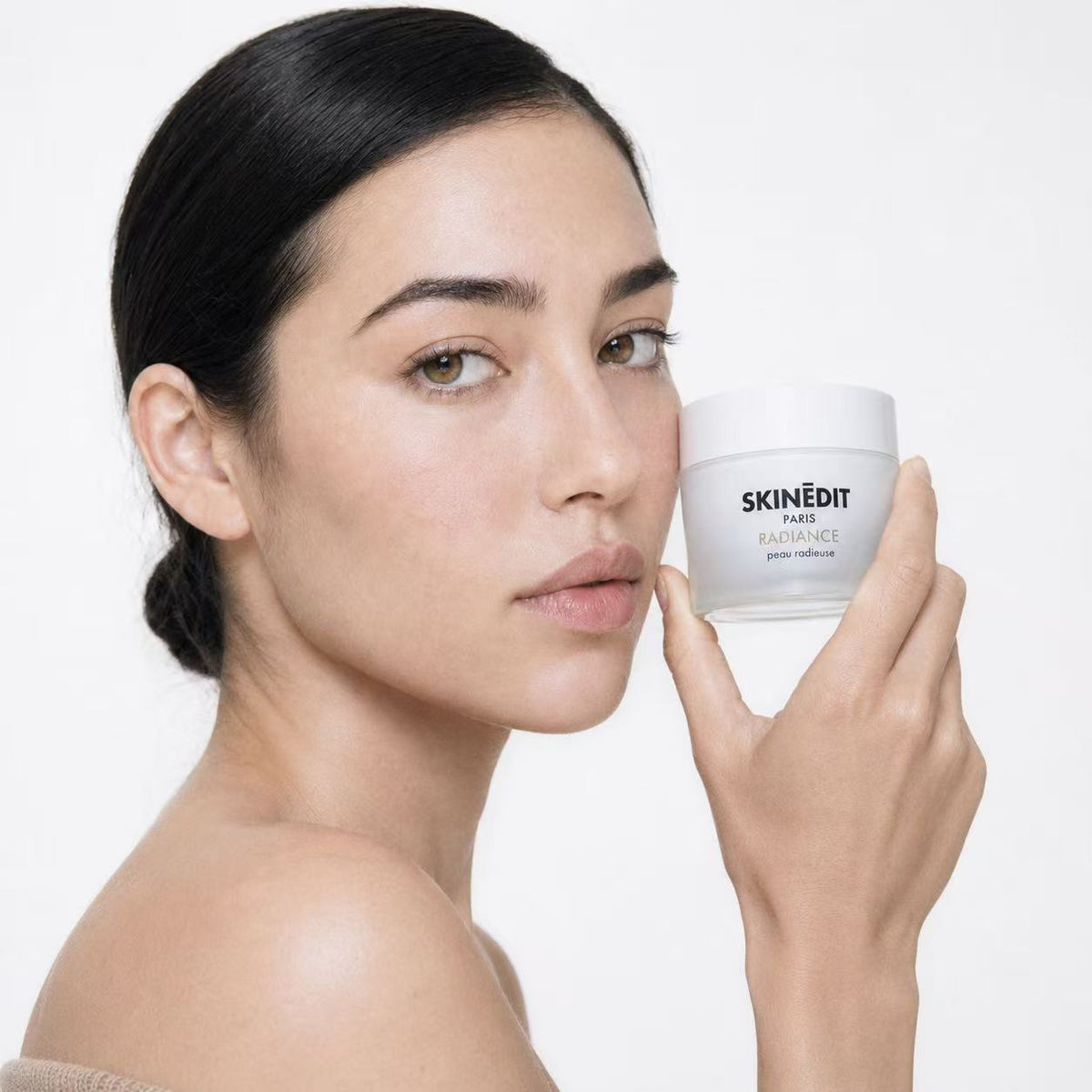
RADIANCE is SKINĒDIT PARIS’s oral protocol for a more even-looking, luminous complexion. Its formulation combines liposomal glutathione with BELIGHT³™, L-cystine, curcumin, selenium and maritime pine, alongside BioPerine®. [6]
This is a formulation approach informed by pigment biology and antioxidant pathways. The glutathione trials discussed here did not test finished RADIANCE. They also do not establish that combining these ingredients reproduces or improves on a particular study result.
For readers considering an oral addition to their routine, the next step is to examine the ingredients, their purpose and the daily protocol. The RADIANCE guided presentation introduces those formulation choices.
How long should you expect to wait?
The pigmentation trials above lasted four or 12 weeks. Those are observation periods, not deadlines by which everyone should see a change. They do not establish one optimal dose or how long any benefit will persist after stopping.
If you assess a routine over time, compare photographs taken in similar lighting, at a similar distance and without filters. Keep a record of other changes, including topical products and sun exposure. Otherwise, it is difficult to know what contributed to an apparent improvement.
What should you know about safety?
Small, short studies cannot establish safety for years of use or for every health situation. Two participants in the 2017 study stopped after temporary liver-enzyme elevations. The 2021 combination trial reported temporary complaints including nausea and skin symptoms in both supplement and placebo groups. [2] [3]
Check the complete formula and avoid duplicating ingredients across supplements. Ask a doctor or pharmacist about suitability if you take medication, have a medical condition, or are pregnant or breastfeeding. Follow the product label rather than increasing amounts to chase a faster cosmetic result. [7]
Oral evidence should not be used to justify cosmetic glutathione injections. Injection introduces different risks; the US FDA has documented adverse events linked to contaminated compounded glutathione injectables. [8]
What remains essential in a dark-spot routine?
Identify the cause of the pigmentation and protect against further darkening. The American Academy of Dermatology recommends broad-spectrum SPF 30 or higher and highlights tinted sunscreen containing iron oxide for visible-light protection when managing dark spots. Treating ongoing irritation or acne also matters. [9]
Glutathione can be considered within that broader discussion. For the practical sequence, read how to build a dark-spot routine from the inside out.
Frequently asked questions
Can glutathione remove dark spots permanently?
Permanent clearance has not been established by the trials discussed here. Selected pigmentation measurements improved in some research, but findings were inconsistent and do not guarantee a visible result for an individual spot.
Is oral glutathione a treatment for melasma?
Healthy-volunteer skin-colour studies do not establish effective melasma treatment. Melasma needs an appropriate assessment and management plan. Our guide to supplements and melasma explains where oral evidence fits.
Does liposomal glutathione work better than regular glutathione?
The liposomal pilot described above measured glutathione levels, not comparative dark-spot results. It cannot establish superior cosmetic efficacy. A convincing comparison would need to test the relevant formulations and measure pigmentation outcomes.
Does RADIANCE contain glutathione?
Yes. RADIANCE includes liposomal glutathione within a broader formulation for complexion concerns. Visit the RADIANCE product page to explore the full ingredient list and daily protocol.
References
- Arjinpathana N, Asawanonda P. Glutathione as an oral whitening agent: a randomized, double-blind, placebo-controlled study. Journal of Dermatological Treatment. 2012;23(2):97–102.
- Weschawalit S, Thongthip S, Phutrakool P, Asawanonda P. Glutathione and its antiaging and antimelanogenic effects. Clinical, Cosmetic and Investigational Dermatology. 2017;10:147–153.
- Sitohang IBS, et al. Multicentre placebo-controlled trial of a glutathione, vitamin C, alpha-lipoic acid and zinc combination. Journal of Clinical and Aesthetic Dermatology. 2021;14:E53–E58.
- Sarkar R, et al. Glutathione as a skin-lightening agent and in melasma: a systematic review. International Journal of Dermatology. 2025;64(6):992–1004.
- Sinha R, et al. Oral supplementation with liposomal glutathione elevates body stores of glutathione and markers of immune function. European Journal of Clinical Nutrition. 2018;72(1):105–111.
- SKINĒDIT PARIS. RADIANCE formulation and daily protocol. Brand product information.
- NIH Office of Dietary Supplements. Dietary supplements: what you need to know.
- US Food and Drug Administration. Safety concerns involving compounded glutathione injectables. 2019.
- American Academy of Dermatology. How to fade dark spots in darker skin tones.
Evidence note: ingredient studies are distinct from finished-product trials. Food supplements do not replace a varied, balanced diet, sunscreen or appropriate medical care.


Jaouad Bentaguena est le fondateur de SKINĒDIT Paris. Il recherche et écrit lui-même le journal Intelligence de SKINĒDIT, à partir de la littérature évaluée par les pairs et en dialogue avec les scientifiques et partenaires cliniques associés aux protocoles, afin de rendre la science profonde de la peau et du cheveu claire et utile.
À propos de l’auteur