What is deep skincare? A science-led guide to topical skincare, ingestible skincare and nutricosmetics — what each route can reach, what the evidence supports, and how they work together.
The short answer: deep skincare is SKINĒDIT’s term for supporting skin and hair biology from within, alongside topical care. It overlaps with ingestible skincare and nutricosmetics, but it is not based on the idea that creams are useless or that “99%” is a literal anatomical measurement. Topicals can meaningfully affect the epidermis and, for some actives, dermal biology. Oral nutrients take a different route: after digestion and absorption, they enter systemic circulation and may influence tissues from within when the ingredient, dose and evidence support that effect.
The important distinction is not surface versus science. It is route versus target. Sunscreen, retinoids and other topical actives can be highly effective for the biology they can influence. Nutrition and oral supplementation act through systemic physiology. A serious skincare strategy can use both.
What is deep skincare?
Deep skincare is a framework for thinking about visible beauty through the biological structures beneath the visible surface: the dermal matrix that contributes to firmness, melanocytes and pigment signalling in the epidermis, the dermal papilla at the base of the hair follicle, and even the facial skeleton that changes with age.
In conventional beauty, the product usually begins outside the body and moves inward. In ingestible skincare, the route begins in the digestive system, enters circulation and reaches tissues through normal physiology. That does not mean an oral ingredient selectively travels to the face or hair follicle. It means that systemic delivery and topical delivery are fundamentally different routes.
The phrase “the 99%” is therefore best understood as a SKINĒDIT shorthand for the deeper biological territory beneath what we see — not as a claim that topical skincare reaches exactly 1% of the skin.
The skin barrier: what topical skincare can and cannot do
The outermost layer of the epidermis, the stratum corneum, is an exceptionally effective barrier. It limits water loss and protects the body from environmental exposure. It also limits passive penetration of many molecules.

A frequently cited principle in dermatology is the 500 Dalton rule: molecules much larger than roughly 500 Da generally have difficulty crossing intact stratum corneum by passive diffusion. That helps explain why a large intact collagen molecule in a cream does not simply travel through the skin and replace dermal collagen.
But “the barrier is difficult to cross” is not the same thing as “topicals only work on dead skin.” Small molecules can penetrate, formulations can alter delivery, and some topical drugs clearly change deeper biology. Tretinoin is the obvious example: randomized trials and systematic reviews show that topical tretinoin can improve photoaged skin and stimulate new collagen formation.
Topical care can also influence pigmentation. Melanin is synthesized in melanocytes located in the basal epidermis, and topical agents such as retinoids, azelaic acid and other pigment-directed treatments can alter melanogenesis or pigment distribution. So it would be scientifically wrong to say that pigment biology is categorically “out of reach” of skincare.
The better distinction is not that creams are superficial. It is that topical and systemic routes influence biology differently.
Three biological territories beneath visible beauty
The deep-skincare framework becomes more useful when it is divided by goal rather than by product category.
1. Firmness: dermal matrix and facial structure
Visible firmness depends partly on the dermis, where fibroblasts maintain collagen, elastin and the extracellular matrix. Topical retinoids can influence this territory, while oral nutrition provides amino acids and micronutrients through circulation. Oral collagen peptides have also been studied: several meta-analyses of randomized trials report improvements in skin hydration and elasticity, although study quality, formulation differences and potential bias matter.
Below the skin, another structure changes with age: the facial skeleton. A 2026 review of facial bone ageing describes region-specific remodelling and resorption involving the orbital rims, maxilla and mandible. Bone is therefore part of facial ageing — but a supplement should not be described as rebuilding facial bone unless that outcome has actually been demonstrated.
2. Clarity: melanocytes, melanosomes and pigment signalling
Melanin is produced inside melanosomes within melanocytes in the basal layer of the epidermis. Tyrosinase is a central enzyme in that pathway. Both topical and oral approaches have been studied for pigmentation, but they work through different mechanisms and should not be treated as interchangeable.
For dark spots, oral antioxidants or pigment-directed nutricosmetic ingredients should be viewed as adjuncts. They do not replace daily sunscreen, and they do not make evidence-based topical treatments irrelevant.
3. Density: the hair follicle and dermal papilla
At the base of the follicle sits the dermal papilla, a specialised mesenchymal signalling niche involved in hair-follicle growth, cycling and hair-shaft characteristics. Changes in dermal-papilla cell number and signalling can contribute to hair thinning.
Again, route matters. Topical minoxidil demonstrates that a topical treatment can influence follicular biology. Oral nutrition can also matter — especially when a true deficiency, inadequate intake or a clinically studied oral active is relevant. Persistent shedding should not be reduced to “take a hair supplement”; iron status, vitamin D, thyroid function and other causes may need assessment.
THE DEEP SKINCARE SYSTEM AGELESS · RADIANCE · REVIVAL — three biological territories, three Protocols →Topical vs ingestible skincare: what is the difference?
| Route | What it does well | What it does not automatically do |
|---|---|---|
| Topical skincare | Barrier care, hydration, photoprotection, exfoliation, retinoid signalling, pigment-directed treatment and other local effects depending on the active. | It does not remodel facial bone or correct systemic nutrient deficiency. |
| Ingestible skincare / nutricosmetics | Supplies nutrients or bioactive compounds through the gastrointestinal tract and circulation; some ingredients have human evidence for skin or hair outcomes. | Reaching the bloodstream does not prove that an ingredient will improve skin, hair or a specific concern. |
Do oral skincare supplements really reach the skin?
Yes in the physiological sense, but the claim needs precision. Nutrients absorbed in the intestine enter circulation and are distributed throughout the body. The skin is vascularised, and living skin cells obtain oxygen and nutrients from the circulation.
What should not be implied is that every capsule ingredient travels intact to the dermis and acts exactly where a brand wants it to. Oral compounds may be digested, metabolised, transformed by the liver, distributed to many tissues or excreted. The relevant question is therefore not simply:
Does it reach the bloodstream?
It is:
Does this specific oral ingredient or formulation have credible human evidence for the outcome being claimed?
That is the standard that separates a plausible nutricosmetic from a long ingredient list.
Does ingestible skincare actually work?
There is no single answer for the entire category because nutricosmetics are not one treatment. Evidence has to be evaluated ingredient by ingredient and formulation by formulation.
Hydrolysed collagen is one of the most studied examples. A 2023 meta-analysis of 26 randomized controlled trials involving 1,721 participants found improvements in skin hydration and elasticity compared with placebo, while also identifying biases and calling for larger high-quality trials. Other reviews have reached broadly favourable conclusions, but heterogeneity between products remains important.
Other oral approaches — including carotenoids, polyphenols, selected botanical extracts, vitamins and minerals — have varying levels of evidence. Some have randomized human trials; others rely mainly on biochemical rationale or small studies. The phrase “clinically studied ingredient” should never be treated as equivalent to “clinically proven finished product.”
Is deep skincare the same as nutricosmetics?
Not exactly. Nutricosmetics is the established industry term for ingestible products intended to support the appearance or condition of skin, hair and nails. “Beauty from within” and “oral cosmetics” are also used.
Deep skincare is SKINĒDIT’s broader framework: start with the biological territory involved in the concern, then ask which route — topical, systemic, behavioural or clinical — can influence it credibly.
That distinction matters because sometimes the best answer is a supplement, sometimes it is sunscreen or tretinoin, sometimes it is correcting iron deficiency, and sometimes the problem is anatomical enough that neither skincare nor nutrition will reverse it.
Why SKINĒDIT uses three Protocols
SKINĒDIT separates three concerns because their biology is different.
- AGELESS is built around firmness, dermal-matrix biology and the structural territory beneath the skin.
- RADIANCE is built around pigmentation, oxidative signalling and visible clarity.
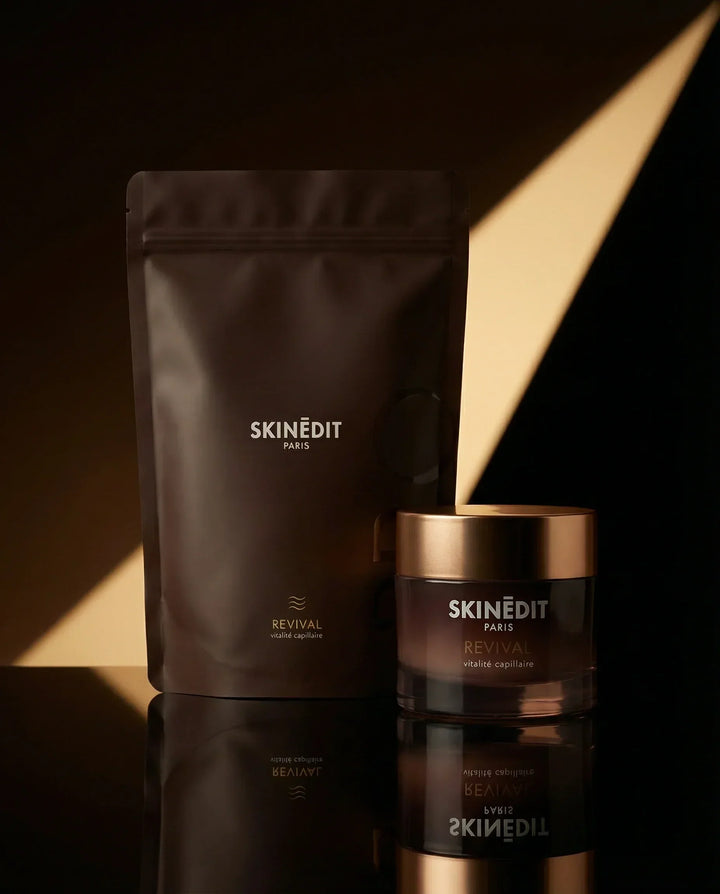
- REVIVAL is built around follicular signalling, anchoring and hair-fibre biology.
The formulations contain different actives because the concerns do not share one universal mechanism. Evidence for an ingredient is also kept separate from evidence for the finished Protocol.
Why 90 days?
There is no single universal “90-day skin renewal cycle.” Epidermal turnover, dermal remodelling, pigment change and hair cycling all occur on different timelines.
Ninety days is useful because many oral skin studies evaluate outcomes over approximately 8–12 weeks, giving gradual biological changes enough time to be measured. Hair often requires longer because the follicle cycle operates over months.
So 90 days should be understood as a meaningful evaluation window, not as a magical biological deadline.
What deep skincare is not
- It is not a replacement for sunscreen. UV protection remains foundational to preventing photoageing and hyperpigmentation.
- It is not a replacement for evidence-based topical treatment. Retinoids and other topical agents can produce genuine biological effects.
- It is not proof that every supplement works. Oral delivery is a route, not an efficacy claim.
- It is not a non-surgical facelift. Supplements cannot mechanically reposition descended tissue or recreate lost facial anatomy.
- It is not necessarily faster. Most meaningful skin and hair outcomes are measured over weeks or months, not days.
Deep skincare is not about choosing inside over outside. It is about matching the route to the biology.
Frequently asked questions
What does deep skincare mean?
Deep skincare is SKINĒDIT’s term for addressing biological processes beneath the visible surface through the route most relevant to them. It includes ingestible skincare and nutricosmetics, but it does not imply that topical skincare is ineffective.
Is “the 99%” a literal measurement of skin depth?
No. The 99% is a brand shorthand for the deeper biological territory beneath the visible surface. It should not be interpreted as a literal claim that topical products act on exactly 1% of skin.
Can skincare products penetrate the dermis?
Penetration depends on the molecule and formulation. The stratum corneum is a strong barrier, but some small topical actives can penetrate and influence deeper biology. Tretinoin, for example, has human evidence for stimulating dermal collagen and improving photoaged skin.
Do supplements really reach the skin?
Absorbed nutrients and metabolites enter systemic circulation, and living skin receives nutrients through its blood supply. But reaching circulation does not automatically prove a visible skin benefit; efficacy has to be demonstrated for the specific ingredient or formulation.
Is ingestible skincare the same as nutricosmetics?
Broadly, yes. Nutricosmetics are oral supplements intended to support the appearance or condition of skin, hair and nails. “Deep skincare” is SKINĒDIT’s wider framework for matching biological depth with the appropriate route of care.
Are oral collagen supplements better than collagen creams?
They are not directly comparable. Intact collagen in a cream does not replace dermal collagen. Hydrolysed oral collagen has been studied in randomized trials and meta-analyses, with reported benefits for hydration and elasticity, although product quality and study bias vary.
Should I stop using creams and serums if I take a skin supplement?
No. Topical and oral approaches do different jobs and can complement each other. Sunscreen, moisturisers, retinoids and other evidence-based topicals remain useful even when an oral protocol is part of the routine.
How long does ingestible skincare take to work?
It depends on the outcome and ingredient. Many skin studies assess changes after about 8–12 weeks. Hair generally requires longer because the hair-growth cycle is measured in months.
Which SKINĒDIT Protocol is right for each concern?
AGELESS is the firmness and structural-ageing Protocol, RADIANCE is the pigmentation and clarity Protocol, and REVIVAL is the hair-thinning and density Protocol.
Related reading
- Topical vs ingestible skincare: which route does what?
- Do collagen supplements work for sagging skin?
- Best supplements for skin firmness and elasticity
- What is the dermal papilla?
- The Calcium Paradox and the bone–skin axis
References
Bos JD, Meinardi MMHM. The 500 Dalton rule for the skin penetration of chemical compounds and drugs. Experimental Dermatology. 2000;9(3):165–169.
Sitohang IBS, et al. Topical tretinoin for treating photoaging: a systematic review of randomized controlled trials. International Journal of Women’s Dermatology. 2022;8(1):e003.
Pu SY, Huang YL, Pu CM, et al. Effects of oral collagen for skin anti-aging: a systematic review and meta-analysis. Nutrients. 2023;15(9):2080.
Lambert MW, Maddukuri S, Karanfilian KM, et al. The physiology of melanin deposition in health and disease. Clinics in Dermatology. 2019.
Morgan BA. The dermal papilla: an instructive niche for epithelial stem and progenitor cells in development and regeneration of the hair follicle. Cold Spring Harbor Perspectives in Medicine. 2014;4(7):a015180.
Zhang HL, Qiu XX, Liao XH. Dermal papilla cells: from basic research to translational applications. Biology. 2024;13(10):842.
Lee KWA, Zamin RZ, Sobchyshyn M, et al. Facial bone aging: an update and literature review. JPRAS Open. 2026;48:828–845.
Dini I, Laneri S. Nutricosmetics: a brief overview. Phytotherapy Research. 2019;33(12):3054–3063.
Evidence note: this article distinguishes route of administration from proven efficacy. Ingredient studies, mechanistic data and evidence from related formulations do not automatically establish the efficacy of a finished SKINĒDIT Protocol. Food supplements are not a substitute for a varied, balanced diet and a healthy lifestyle.

Jaouad Bentaguena est le fondateur de SKINĒDIT Paris. Il recherche et écrit lui-même le journal Intelligence de SKINĒDIT, à partir de la littérature évaluée par les pairs et en dialogue avec les scientifiques et partenaires cliniques associés aux protocoles, afin de rendre la science profonde de la peau et du cheveu claire et utile.
À propos de l’auteur