Some beauty supplements improve specific skin or hair measurements, but results depend on the formula and the concern. Human studies support selected interventions for hydration, elasticity, pigmentation and certain hair outcomes. The evidence is uneven: a promising ingredient study does not establish that every product containing it works, and a statistically significant change may not be a noticeable transformation.
If you are considering a supplement, you deserve more than a promise of “glow”. This SKINĒDIT PARIS review explains what current research can tell you, where uncertainty remains, and how that evidence relates to AGELESS, RADIANCE and REVIVAL.
Do beauty supplements work? The evidence at a glance
| Concern | What research suggests | Main limitation |
|---|---|---|
| Hydration and elasticity | Collagen peptide studies often report improvements. | Results depend on study quality and the formulation tested. |
| Wrinkles and firmness | Some oral interventions improve selected measurements. | Better hydration or elasticity does not establish a visible lifting effect. |
| Dark spots | Defined formulations such as BELIGHT³™ have controlled pigmentation studies. | Findings cannot be extended to every brightening supplement or type of pigmentation. |
| Thinning and shedding | Some formulas improve selected hair measures. | Results vary by outcome; supplements do not address every cause of hair loss. |
| Biotin for hair | Deficiency can cause hair changes and needs correction. | Deficiency is uncommon; evidence for extra biotin in people without deficiency is limited. |

Nutricosmetics is another name for supplements developed around cosmetic goals. It describes a category, rather than one treatment: collagen peptides, botanical extracts and vitamin combinations should each be judged on their own evidence.
What does the research show for skin?
Collagen has a substantial research base, with important qualifications. A 2026 meta-analysis of 35 trials reported improvements in hydration and elasticity; findings for wrinkles and dermal density were less reliable in sensitivity analyses.[1]
A 2025 review of 23 randomised trials found overall benefits, but these were not statistically significant in its higher-quality or non-industry-funded study subgroups.[2] Taken together, the reviews suggest potential benefits while leaving uncertainty about their size, consistency and relevance to a particular product. Read our closer analysis of collagen supplements for sagging skin.
The wider literature also needs careful interpretation. A 2025 review included 61 dietary-intervention studies: 47 randomised trials and 14 uncontrolled or open-label studies. Its pooled estimates used before-and-after changes, rather than consistently comparing supplements against placebo.[3] Reported improvements across several ingredient categories are useful research signals, but cannot all be attributed confidently to the intervention.
Can supplements improve dark spots?
Some defined oral formulations have controlled human data. BELIGHT³™, a combination of grape-seed, grape-pomace and licorice extracts with vitamin C, was assessed in two randomised, double-blind, placebo-controlled studies. One enrolled 58 Asian adults; the other enrolled 66 Caucasian adults. Both reported improvements in selected pigmentation measurements over 12 weeks compared with placebo.[4] [5]
These results concern that specific formulation. The 2023 study excluded melasma, so it does not establish a treatment for melasma. Daily sun protection remains central to a pigmentation routine; see our guide to dark spots and nutritional support.
Do hair supplements improve growth or shedding?
A 2026 systematic review examined 14 studies involving 967 participants. Selected comparisons favoured supplements for measures including growing-phase hair density and hair-pull results; participants also reported improvements in thickness and shedding. However, the pooled difference in total hair count was not statistically significant.[6]
This supports a narrower conclusion than “hair supplements regrow hair”. Different formulas were studied in different populations, and a change in one measurement does not establish improvement in every aspect of hair growth.
Correcting a nutritional deficiency is a separate question. Biotin deficiency is uncommon, and evidence for routine supplementation in people without deficiency is limited.[7] Persistent or unexplained hair loss deserves assessment; blood tests should follow the history and examination rather than a universal supplement checklist.[8]
What does “clinically studied” actually tell you?
First identify what was tested:
- An ingredient: research may concern a particular extract, peptide or nutrient form.
- A defined blend: a combination was studied at specified amounts; the results belong to that combination.
- The finished product: researchers evaluated the formula sold to customers.
Then examine the study design. A finished-product evaluation without a control group still cannot separate product effects from changes that might have happened anyway. A randomised placebo-controlled trial offers a stronger comparison, but its size, methods, participants and funding still matter.
Finally, ask whether the result matches the promise. An instrument detecting a small change in elasticity is different from participants reporting firmer skin. Neither automatically demonstrates a visible lift. Mechanisms and laboratory experiments help explain a formulation; human outcomes are needed to assess its cosmetic effects.
Discover the thinking behind each formula.
Firmness, complexion clarity or hair vitality: explore the ingredients, research and daily routine behind AGELESS, RADIANCE and REVIVAL. Find the protocol that speaks to your priority.
How does this evidence relate to SKINĒDIT?
Each protocol has a different formulation and evidence profile. Understanding those differences makes it easier to explore the one relevant to you.
AGELESS: a finished-formula evaluation
AGELESS combines thirteen actives around structural physiology, the dermal matrix, and cellular energy and antioxidant defence. Its independent 90-day COMPLIFE® evaluation enrolled 33 women, with 32 completing. Instrumental measurements and questionnaires were used; 96.9% of completers reported firmer or more elastic skin by self-assessment.[9]
The evaluation was open-label and single-arm, without a placebo or parallel control. It provides observations on the complete formula, but cannot establish how much change AGELESS caused. Discover the AGELESS formulation and its 90-day results.
RADIANCE: pigmentation ingredient research
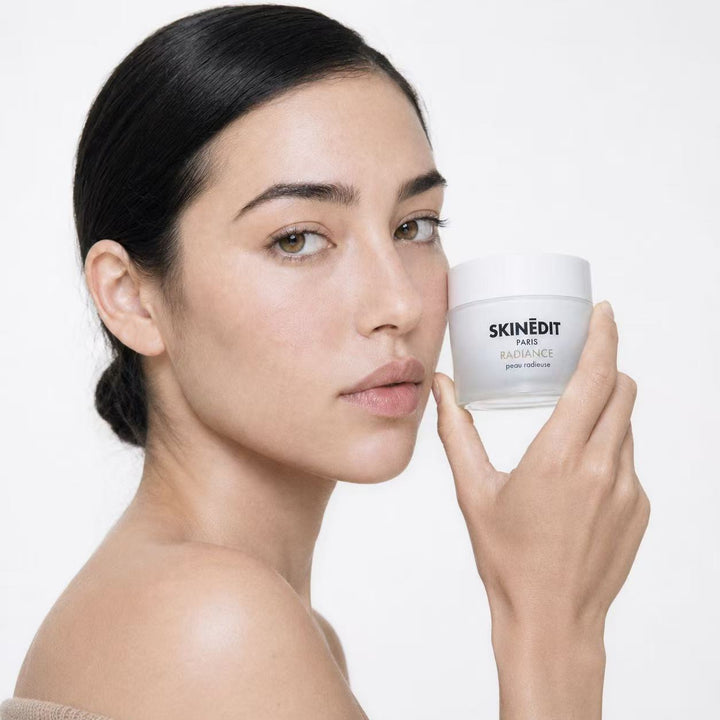
RADIANCE combines BELIGHT³™ with other ingredients selected around pigmentation and oxidative stress, including glutathione, L-cystine and selenium. The BELIGHT³™ trials described above concern that defined ingredient formulation; they are not finished-product RADIANCE trials. Each additional ingredient has its own rationale and evidence. Explore RADIANCE and the thinking behind the complete formula.
REVIVAL: hair ingredient research
REVIVAL includes AnaGain™ Nu pea-sprout extract, Cynatine® HNS keratin and supporting nutrients. A 90-day placebo-controlled trial in 50 women assessed Cynatine® HNS with vitamins and minerals and reported improvements in selected hair measures.[10] This tested neither isolated keratin nor finished REVIVAL. Discover REVIVAL and the ingredients behind its hair protocol.
How long should you allow before assessing results?
Use the relevant study period as context. The BELIGHT³™ trials assessed outcomes at 12 weeks; the AGELESS evaluation and Cynatine® HNS trial ran for 90 days. These are observation periods, not guaranteed deadlines for an individual result.
Start with a specific concern and keep your routine consistent. Photographs in similar lighting can help you observe changes, although they cannot prove what caused them. If hair loss progresses or a skin change is unexplained, seek assessment rather than repeatedly extending a supplement course.
What should you check before starting?
Review the complete label, daily serving and overlapping nutrients across products. If you take medicines, have a medical condition, are pregnant or are breastfeeding, check suitability with a clinician or pharmacist. Tell your clinician about biotin-containing supplements before blood tests: biotin can interfere with some results.[7]
For help turning the evidence into a shortlist, read our guide to choosing skin and hair supplements.
Frequently asked questions
Which beauty supplements have the strongest evidence?
The answer depends on the outcome. Collagen has many skin trials, but their quality and results vary. Defined pigmentation blends and some hair formulas have controlled studies. Compare research on the exact formulation and concern rather than treating one ingredient as best for everything.
Are gummies less effective than capsules?
The format alone does not establish efficacy. What matters is the formulation, daily amount, stability and relevant human evidence. A capsule is not automatically better researched than a gummy or powder.
Does “clinically tested” mean results are guaranteed?
No. Check what was tested, whether there was a control group and what improved. An average study result does not predict every person's response, and a measurable change may be too small to notice.
Are expensive beauty supplements more effective?
Price alone does not establish efficacy. Consider the relevance of the formula, transparency of the evidence and cost across your intended routine. A useful product should make its ingredients, purpose and research limits easy to inspect.
Related reading
- What are nutricosmetics?
- Choosing supplements for women's hair thinning
- Does biotin work for hair growth?
References
- Batool A, Abbas MS, Farooq R, et al. Oral collagen peptides and skin rejuvenation: a systematic review and an updated meta-analysis of randomized controlled trials. Journal of Cosmetic Dermatology. 2026;25:e71041.
- Myung SK, Park Y. Effects of collagen supplements on skin aging: a systematic review and meta-analysis of randomized controlled trials. The American Journal of Medicine. 2025;138:1264–1277.
- Ng JY, et al. Dietary interventions in skin ageing: a systematic review and meta-analysis. Journal of Physiological Anthropology. 2025;44:26.
- Pouchieu C, Pourtau L, Gaudout D, et al. Effect of an oral formulation on skin lightening: results from in vitro tyrosinase inhibition to a double-blind randomized placebo-controlled clinical study in healthy Asian participants. Cosmetics. 2023;10:143.
- Tursi F, Pourtau L, Roveda G, et al. Clinical efficacy of Belight³™ on dark spot pigmentation in Caucasian subjects. Cosmetics. 2025;12:27.
- Alanazi R, et al. Evaluating the effectiveness of commercial oral supplements for hair growth: a systematic review and meta-analysis. Journal of Cosmetic Dermatology. 2026;25:e70817.
- NIH Office of Dietary Supplements. Biotin: Fact sheet for health professionals.
- American Academy of Dermatology. Hair loss: Diagnosis and treatment.
- SKINĒDIT PARIS. AGELESS: published summary of the 90-day COMPLIFE® evaluation. Manufacturer-published summary of an independent, open-label, single-arm finished-product evaluation; not a placebo-controlled journal publication.
- Beer C, Wood S, Veghte RH. A clinical trial to investigate the effect of Cynatine HNS on hair and nail parameters. The Scientific World Journal. 2014;2014:641723.



Jaouad Bentaguena is the founder of SKINĒDIT Paris. He researches and writes the SKINĒDIT Intelligence journal himself — working from peer-reviewed literature and alongside the scientists and clinical partners behind each protocol, to translate deep skin and hair science into something clear enough to act on.
About the author