At 40, forehead lines that remain at rest can reflect both repeated expressions and changes in the skin. Moisturising can soften the appearance of fine surface lines; an established crease calls for a broader assessment. Start with what you see, then choose a routine that fits your skin and the result you want.
Your eyebrows are relaxed, but two or three horizontal lines remain. They catch the light or collect foundation. You would like a smoother-looking forehead while keeping an expressive face. Before changing your cream, consider movement, the skin’s surface and overall skin quality separately.
Why do forehead wrinkles remain at rest?
Horizontal forehead lines form as the frontalis muscle raises the eyebrows. Dynamic lines appear with expression; static lines remain when the face is relaxed. Over time, movement-related folds can become visible at rest. Sun exposure and skin ageing also influence their appearance. [1]
These lines differ from the frown lines between the eyebrows. Naming the location helps you set a clearer goal: “the horizontal lines on my forehead at rest” is more specific than “a less tired face.”
Is it normal to have forehead wrinkles at 40?
Yes. Their presence does not mean you have neglected your skin. There is no universal birthday when forehead lines begin. Genetics, expressions and past sun exposure contribute to differences between faces. Forty is a personal milestone, rather than the same biological threshold for everyone. [1,2]
Different lighting or makeup can also draw attention to existing lines. Your goal can remain considered: more comfortable skin, a more even-looking surface and a ritual you enjoy following.
Three observations to guide your next step
- The line appears mainly when you raise your eyebrows. Expression plays an important role. If you wish to change it, a doctor can assess suitable options.
- The line remains with your forehead relaxed. Consider its apparent depth and how much it bothers you. Skincare may improve aspects of the skin without guaranteeing that a crease disappears.
- Fine lines vary with skin comfort. Review cleansing and moisturising first. Our guide to dehydration lines and wrinkles explores this distinction.
These observations are not a diagnosis. They help you describe your priorities without inspecting your face repeatedly throughout the day.
Which skincare routine makes sense for forehead lines?
Protect this exposed area
The forehead receives regular UV exposure. Before going outdoors, use broad-spectrum SPF 30 or higher according to its instructions, alongside shade and a hat as appropriate. Sun protection is a foundation of care for ageing skin. [3]
Keep moisturising comfortable
A mild cleanser and a suitable moisturiser help avoid a routine that leaves skin tight or irritated. Moisturising can make fine lines less noticeable. A comfortable surface improvement is worth maintaining, even if a deeper crease remains visible. [3]
Choose an active rather than an accumulation
A topical retinoid can be suitable for some fine lines. Tolerance matters: introduce it gradually, following the product instructions or your dermatologist’s advice. Seek advice if your skin is reactive or persistently irritated. Retinoids should not be used during pregnancy. [4]
Burning should not become the price of an ambitious skincare routine. Give each step a purpose and avoid introducing several new products at once.
AGELESS: another dimension of skincare, from within
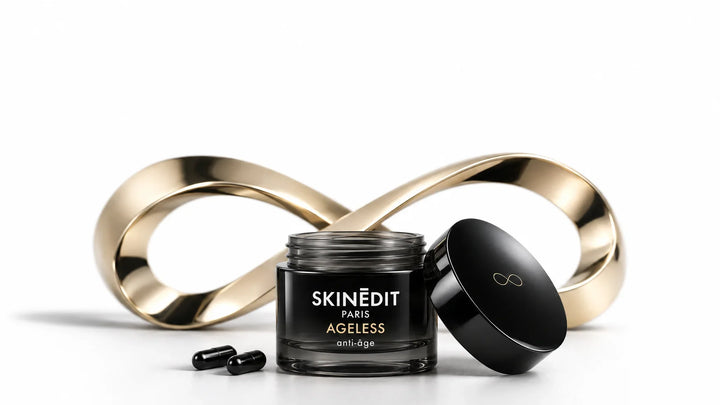
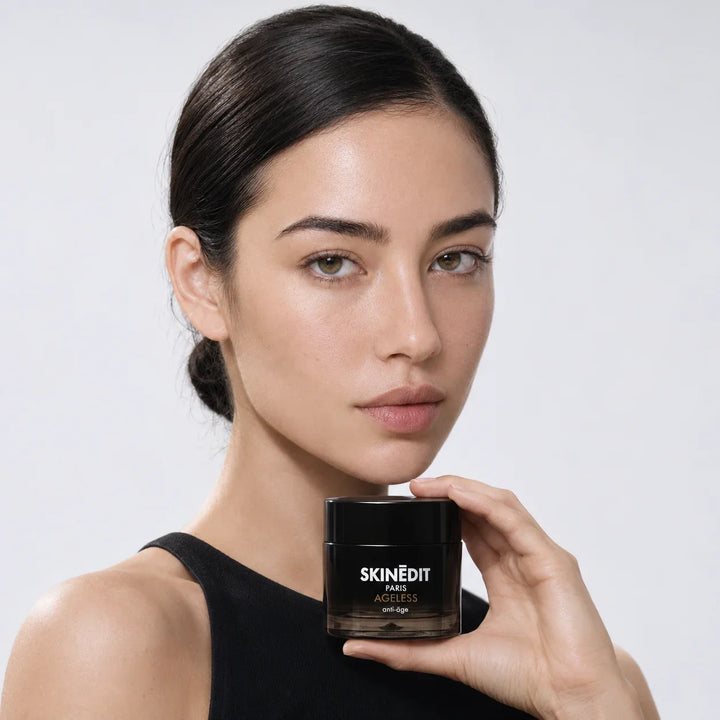
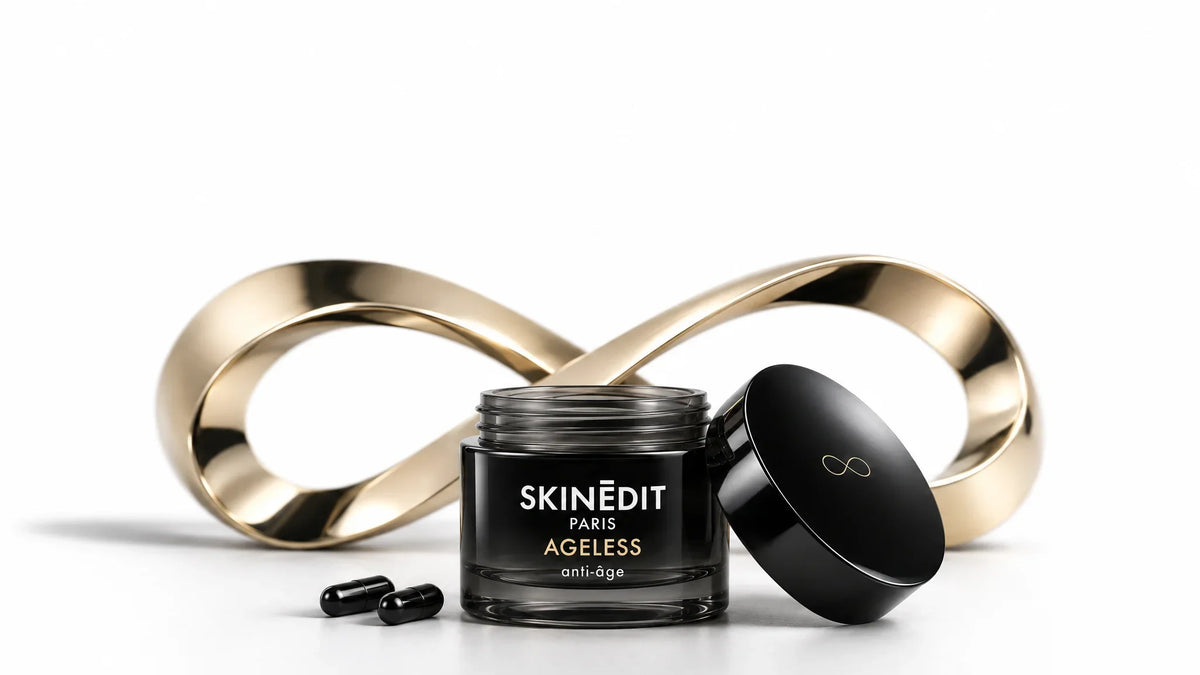
At SKINĒDIT PARIS, the future of skincare also begins within. AGELESS expresses this vision in a collagen-free formula, made in France, with thirteen selected actives organised around three formulation axes: Structure, Matrix and Cellular Energy.
Its two-capsule daily ritual fits alongside topical skincare. For women who choose their routine carefully, documentation matters too: the complete AGELESS formula has undergone an independent evaluation at Complife Italia, beyond studies of individual ingredients alone.

What was measured, and where?
In the 90-day evaluation, the 32 women who completed the protocol showed mean increases of 29.4% in skin hydration and 3.2% in R2 elasticity. The depth of crow’s-feet wrinkles, measured by 3D profilometry, decreased by an average of 11.2% from baseline.
This wrinkle measurement concerns the outer corner of the eye, not the forehead. The evaluation provides no quantified result specific to horizontal forehead wrinkles and cannot establish that they will disappear. It documents skin-quality parameters under the conditions studied.
Complife Italia: 33 women enrolled, aged 37–60; 32 completed. Open-label before-and-after evaluation without a placebo group, using two capsules each evening and a common base cream for 90 days. These conditions do not isolate the capsules’ contribution. Individual results vary. Read the full results and method.
When should you discuss forehead wrinkles with a doctor?
If an established crease bothers you and you want targeted correction, a consultation can assess your skin, brow movement and expectations. Botulinum toxin works on muscle activity; other approaches address different goals and carry their own risks. Our guide to injectables and skin quality helps prepare this conversation. [1,5]
A consultation does not commit you to a procedure. Ask about realistic results, duration, risks and alternatives. Share your complete routine, including medicines and supplements.
How can you review your routine?
Choose a few simple reference points: forehead comfort, how makeup sits and the appearance of lines at rest. For photographs, use the same lighting, angle and relaxed expression. Filters and side lighting can substantially change what you see.
AGELESS was evaluated at 90 days. This duration describes the studied protocol, without promising a personal deadline or a forehead-specific result. A stable routine helps you judge what suits you.
Your questions about forehead wrinkles at 40
Can a cream make a forehead wrinkle at rest disappear?
It may improve hydration and the appearance of fine lines. An established crease can remain visible. If you want to correct it specifically, seek an individual assessment rather than layering more creams.
Do horizontal forehead lines and frown lines need the same care?
Basic skincare may be shared, but the lines occur in different areas and involve different movements. A medical treatment is chosen after examining the relevant area.
Has AGELESS been tested specifically on forehead wrinkles?
The published instrumental wrinkle-depth measurement concerns crow’s feet. The evaluation establishes no percentage reduction for forehead lines. Consider AGELESS for its formulation and place in a skin-quality routine, with that distinction in mind.
Bring greater intention to your ritual.
Explore the thirteen actives, formulation choices and independent 90-day evaluation. A further dimension to consider alongside the skincare your skin already enjoys.
Sources
- DermNet: facial lines, including dynamic and static wrinkles.
- American Academy of Dermatology: factors in premature skin ageing.
- American Academy of Dermatology: skin care in your 40s and 50s.
- American Academy of Dermatology: retinoids and retinol.
- NHS: before a cosmetic procedure.
- SKINĒDIT PARIS: AGELESS 90-day evaluation and method.
By SKINĒDIT PARIS, creator of AGELESS. General information, not an individual diagnosis. AGELESS is a food supplement. Follow its instructions and precautions; seek advice if taking medication, particularly a vitamin K antagonist anticoagulant. It does not replace a varied, balanced diet or a healthy lifestyle.

Firmness begins with a deeper understanding.
Curious about the formulation behind AGELESS? Explore its selected ingredients, the thinking behind their combination and the daily ritual.
Intelligence is the editorial journal of SKINĒDIT PARIS, exploring skincare, ingredients and the evidence behind beauty routines.
About the author